
Training and consultancy services to businesses,
drivers and professionals throughout Yorkshire and the UK.
Call 07539 920 140
ADR Training
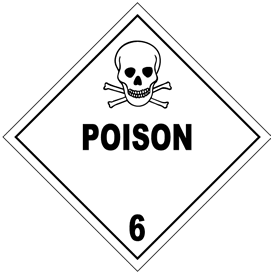
Class 6 – Toxic and infectious
Class 6.1 – Toxic
These substances cause damage to the health of humans and animals. They can kill quickly (acute) or slowly (chronic). Toxic substances enter the body in five ways:
Absorption – through skin
Inhalation – breathed in
Ingestion – swallowed, through food or drink
Injection – through cuts, or through piercing of skin
Instillation – absorbed in the tear fluid of eyes
The level of effect depends on the type of toxic substance and the dose subjected to. Toxic substances are measured on three criteria – their level of toxicity when absorbed through the skin, when ingested and when inhaled. The toxicity is measure in the lethal dose required to kill 50% of a population of test subjects, otherwise known as the LD50 (measured in mg/kg of body weight). For inhalation, this is measured as the LC50, the lethal concentration to kill 50% of test subjects (measured in mg/L).
Any exposure to toxic substances must be followed up with professional medical consultation, as the effect of the toxic product may take time for symptoms to appear. The packing groups depend on the exposure time and the time it takes for symptoms to appear.
Toxic substances are never also infectious, although Class 6 is toxic and infectious. Class 6.1 may also have subsidiary hazards, such as flammable, oxidising or corrosive.
The PPE required is a minimum of eye protection, gloves, high visibility vest and respirator. Full body chemical protective suits may be appropriate.
Class 6.2 – Infectious substances
This sub-class is further divided into two categories:
Category A – infectious diseases that can cause permanent disability or death to humans and/or animals. Examples include covid, flu, smallpox, rabies, ebola, hepatitis B and herpes B.
Category B – anything that doesn’t appear in Category A (this is the actual definition!). These are unlikely to cause disease, but there is a risk present. These include diagnostic specimens, clinical and sanitary wastes and used needles.
For this category, only a 2kg extinguisher is required. If any contamination of the vehicle bed is detected, it must be disinfected. If the vehicle bed is wooden, the parts are removed and burnt.
Any leakage of class 6.2 category A or B must be isolated and reported, so specialist teams can properly clean the spillage.

Top quality training across the UK!